
Online Poker Guide 2026
Online poker combines chance, mathematics, psychology and repeated decision-making. This guide gives new players a practical route from the first Texas Hold’em hand to choosing a room, understanding bonuses, withdrawing funds and studying deeper strategy concepts such as equity, expected value and pot odds.
New to online poker?
Poker differs from most casino games because you usually compete against other players rather than against a fixed house outcome. The operator earns revenue through rake or tournament fees, while players make decisions using incomplete information. Strong results therefore depend on selecting playable hands, understanding position, choosing sensible bet sizes and controlling emotional decisions.
Build a five-card hand
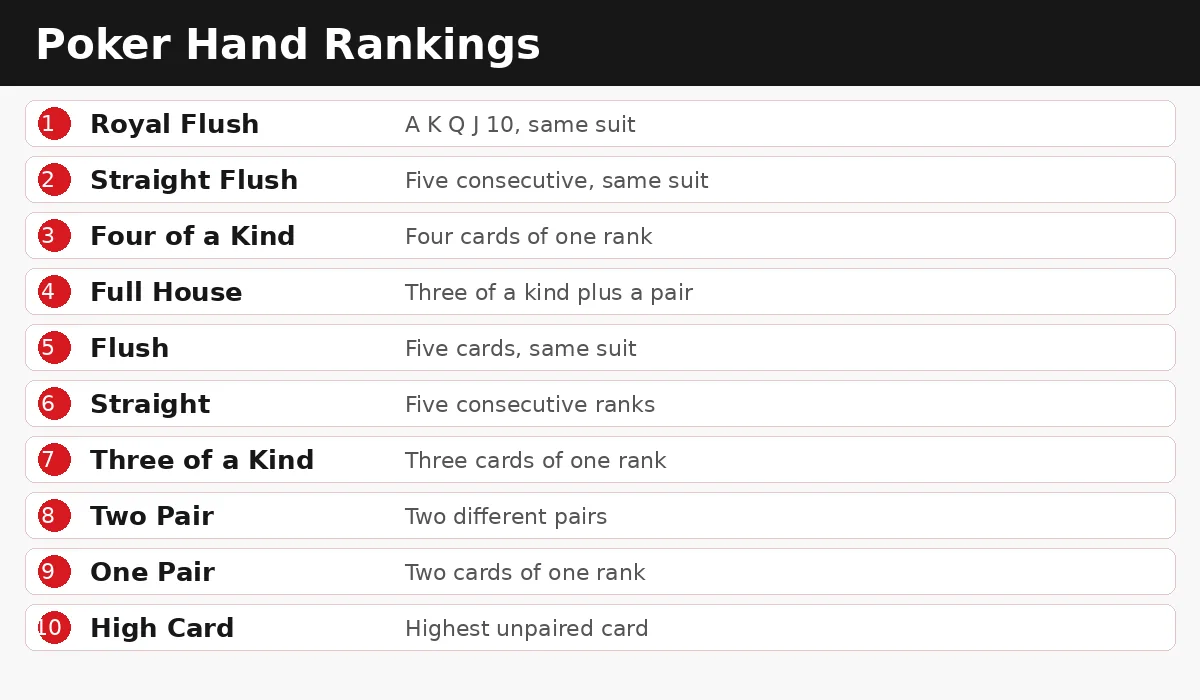
Texas Hold’em gives each player two private cards and up to five shared community cards. Your final result uses the strongest five-card combination available.
Win without showdown
A player can win by holding the best hand or by betting in a way that causes every opponent to fold before cards are revealed.
Position matters
Acting later provides more information. Beginners should generally play more hands from late position and fewer from early position.
Rules of Texas Hold’em
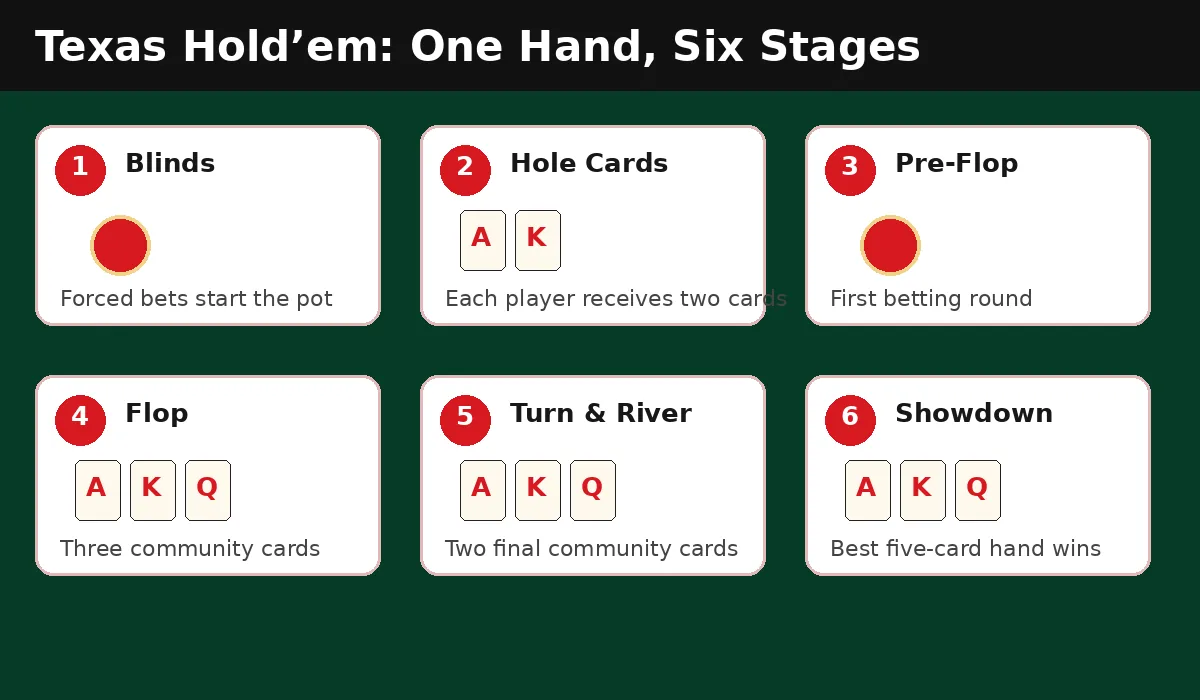
Beginner focus: learn the hand rankings, start with strong opening hands, respect position and avoid calling large bets simply because you have already invested chips.
Online poker formats compared
| Format | Structure | Main skill | Bankroll pressure | Best for |
|---|---|---|---|---|
| Cash game | Chips have direct cash value; join and leave between hands | Deep-stack decisions and table selection | Flexible but can create repeated reloads | Players who prefer steady sessions |
| Sit & Go | Starts when a fixed number of seats fill | Adjusting as blinds rise and players bust | Defined buy-in per event | Beginners who want a clear tournament arc |
| Multi-table tournament | Large field with scheduled start | Patience, stack management and late-stage pressure | High variance | Players seeking deep runs and larger prizes |
| Spin-style tournament | Very short, usually three players, randomized prize pool | Heads-up and short-stack play | Very high variance | Fast-action specialists |
| Fixed Limit Hold’em | Bet sizes are predetermined | Value, pot odds and disciplined calls | More controlled per decision | Players who prefer structured betting |
No-Limit Hold’em beginner strategy
No-Limit Hold’em allows a player to wager any amount up to the full stack. That flexibility makes it exciting, but it also magnifies mistakes. The best beginner approach is selective and position-aware rather than aggressive for its own sake.
Play tight early
Fold weak offsuit hands from early position. Strong starting ranges reduce difficult post-flop situations.
Open wider in position
Late position lets you observe more action before deciding. Use that information advantage carefully.
Value bet clearly
At lower stakes, many opponents call too often. Bet strong hands for value instead of relying on elaborate traps.
Use consistent sizing
Choose sizes based on pot, board texture and objective—not on whether you feel nervous or excited.
Avoid stack-off autopilot
One pair is not always strong enough for a large pot, especially on coordinated boards against tight opponents.
Review difficult hands
Save hand histories and study close spots after the session instead of trying to solve everything while emotional.
Fixed Limit Hold’em beginner strategy
Fixed Limit Hold’em restricts each bet and raise to predetermined amounts. Because a single wager cannot threaten an entire stack, more players reach later streets and mathematical call decisions become especially important.
- Start with strong hands because multiway pots reduce the value of weak pairs.
- Value bet more often when ahead; the limited bet size makes calls common.
- Use pot odds carefully because many draws receive a mathematically reasonable price.
- Do not chase every draw merely because the bet looks small—the accumulated cost across streets matters.
- Respect raises from tight players, especially on the turn where the betting limit usually doubles.
Deposits, finding a room and signing up
Deposit safely
Use a payment method in your own name. Check minimums, fees, currency conversion and whether the method supports withdrawals before depositing.
Finding the right room
Compare provincial eligibility, game traffic, software stability, tournament schedule, rake, support and withdrawal reputation.
Signing up
Use accurate personal details, a unique password and two-factor authentication where offered. Expect identity verification before or during withdrawal.
Bonuses explained
Poker bonuses commonly release in pieces after earning points or paying rake. A large headline amount may require substantial volume and can expire.
Cash out carefully
Complete verification early, review withdrawal limits and keep transaction references. Do not describe normal variance after withdrawing as a “cash-out curse.”
Exchange rates
If the room and your payment account use different currencies, conversion spreads can affect deposits, balances and withdrawals. Check the rate source and fees.
Online poker strategy hub
Equity versus expected value
Equity is your estimated share of the pot if all remaining cards were dealt. Expected value includes equity, fold probability, bet size and future action. A hand can have decent equity yet still be a losing call if the price is wrong.
How often should you bluff?
Bluff when the opponent can fold and your line credibly represents a strong hand. Boards that favour your range, blocker effects and sensible bet sizes matter more than reaching a fixed bluff percentage.
Knowing the correct play
The best decision depends on ranges, position, stack depth, pot size, player tendencies and tournament incentives. Study principles rather than memorizing one action for every hand.
Common poker mistakes
Playing too many hands, calling too much out of position, ignoring stack sizes, bluffing players who never fold and continuing while tilted are costly recurring errors.
Sets versus trips
A set uses a pocket pair plus one matching board card. Trips use one hole card plus a paired board. Sets are usually better disguised and less likely to share the same rank with an opponent.
Split-pot math
When hands tie, divide the pot among winning players after rake according to the room’s rules. Odd chips are allocated by position or suit conventions depending on the platform.
Working out odds and poker math
Compare the call amount with the total pot after calling. Calling $10 to play for a final $50 pot means you are contributing 20% of that total and generally need more than 20% equity before considering future action.
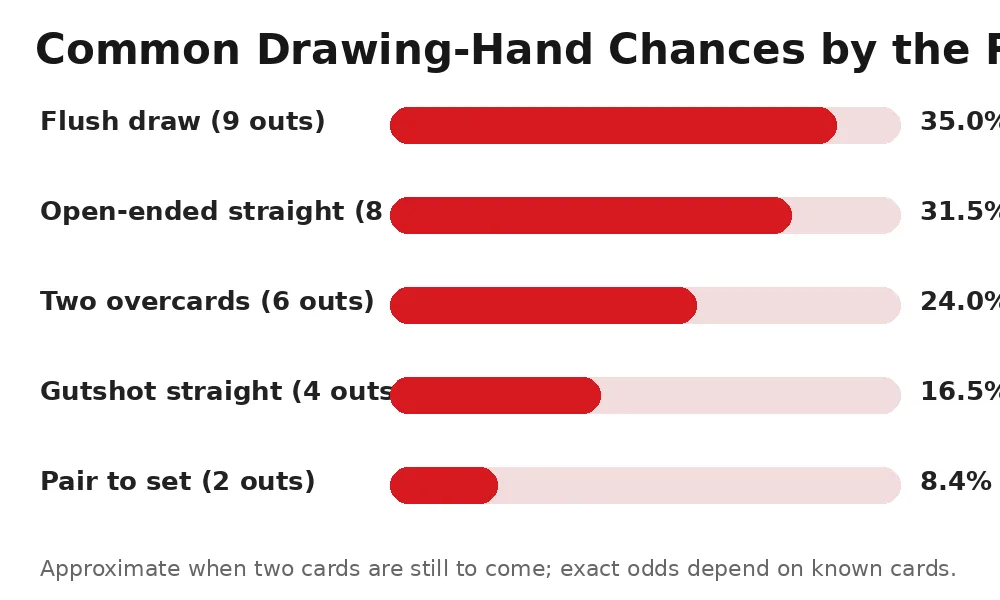
With one card to come, multiply outs by about 2 for a rough percentage. With two cards to come, multiply by about 4. This shortcut is approximate and works best for quick table decisions.
A card is only a useful out if it usually gives you the best hand. A flush card that pairs the board or completes a stronger draw may be contaminated.
Future bets can make a marginal call better when opponents are likely to pay you after you improve. Reverse implied odds describe the opposite danger: improving to a second-best hand.
Online poker myths, alcohol and tilt
| Claim | Reality | Better response |
|---|---|---|
| “The site is rigged because I lost with Aces.” | Premium hands still lose a meaningful percentage of the time, and online volume makes rare events appear frequently. | Review a large sample, verify licensing and separate bad luck from decision quality. |
| “Withdrawing causes a cash-out curse.” | A withdrawal does not change card distribution. The belief usually grows from normal variance and selective memory. | Track results objectively and keep poker funds separate from withdrawals. |
| “A bonus is free cash.” | Most poker bonuses require rake or play volume and may expire before full release. | Calculate realistic release value before depositing. |
| “Playing drunk makes me unpredictable.” | Alcohol usually damages attention, sizing, memory and emotional control more than it confuses opponents. | Do not play real-money poker while impaired. |
| “I am due to win after a losing streak.” | Cards do not remember previous outcomes. Variance can continue longer than expected. | Use stop limits, bankroll rules and hand review instead of chasing. |
Beginner checklist before playing
Online poker FAQ
What game should a beginner learn first?
No-Limit Texas Hold’em is widely available, but begin with play money, micro stakes or small Sit & Go events while learning hand selection and position.
Is poker mainly luck or skill?
Chance dominates individual hands, while skill becomes more visible across repeated decisions and larger samples.
How much should I deposit?
Only deposit an amount that fits a separate entertainment budget and supports the small stakes you plan to play.
Are bonuses free money?
No. They usually release through rake or points and can have expiry and eligibility conditions.
Is online poker rigged?
Choose licensed, transparent rooms and assess fairness through testing and long-term evidence, not one losing session.
How often should I bluff?
Bluff selectively when opponents can fold and your betting line makes sense. Beginners should usually emphasize value first.